- Practically AI
- Posts
- 🧠 What Happens When AI Agents Compete, Collaborate, and Need Management
🧠 What Happens When AI Agents Compete, Collaborate, and Need Management
Today in AI: Agent competitions go live, AI coding gets a product manager, and OpenAI turns Codex into a full command center.
👋 Hello Hello,
How’s the first Monday of the second month treating you?
We’re starting the week off strong. Agents are talking to each other, video models are getting production-ready, and bots are starting to speak instead of just typing. It’s a reminder that we’re no longer just prompting machines. We’re shaping the environments they operate in.
Let’s dig in.
🔥🔥🔥 Three big updates
If you saw yesterday’s Moltbook update, this is the next escalation. BotGames is being pitched as the “ESPN for AI agents.”
On BotGames, you can create and coach your own AI agent (called a ClawdBot), define its strategy in an agent configuration file, and send it into one-on-one competitive games. The first game is Rock Paper Scissors — chosen deliberately because it’s universally understood and strategy-heavy despite its simplicity.
Agents compete in ranked matchmaking, climb leaderboards, and earn ELO scores. You don’t even need to participate directly — you can spectate matches live as agents play each other.
This reframes agent evaluation. Instead of benchmarks or static tests, agents are being stress-tested in dynamic, adversarial environments. That’s closer to how autonomous systems will behave in the real world — interacting, adapting, and sometimes failing in public.
Claude Code is an AI coding environment built around long-running, agent-assisted development work. A new open-source project now adds a dedicated “Product Manager” layer on top of it.
This PM agent focuses on planning, task breakdown, prioritization, and verification — not just writing code. It’s designed to guide development the way a human PM would, keeping scope clear and progress measurable.
As AI coding tools get more powerful, coordination becomes the bottleneck. This shows a shift from “AI writes code” to “AI manages software work.” For teams experimenting with agent-driven development, this is a glimpse of what structured AI collaboration could look like.
OpenAI has released Codex as a dedicated app — a command center for building with multiple AI agents at once.
The Codex app enables you to run agents in parallel using isolated worktrees, create and refine plans before writing code, and select interaction styles according to your desired level of involvement. You can also connect Codex to tools like Vercel, Figma, and Linear, and automate recurring engineering tasks in the background.
It’s available on macOS now, with Windows coming soon. Additionally, paid users are receiving double the rate limits, and Codex is currently available on both Free and Go plans. This turns AI coding into an environment, not a chat. It’s designed for sustained work, not one-off prompts — a big step toward AI as a true development partner.
🔥🔥 Two Pro Tips Worth Knowing
1. 📈 TradingAgents (multi-agent trading research framework)

TradingAgents is an open-source framework that breaks down market analysis into specialized AI roles. Different agents handle fundamentals, technical indicators, news analysis, and sentiment — then combine their insights into bullish or bearish signals.
It’s explicitly built for research, not financial advice, and is useful for understanding how multi-agent systems collaborate on complex decisions.
Best for developers and researchers exploring agent orchestration, decision aggregation, and system design — not for day trading.
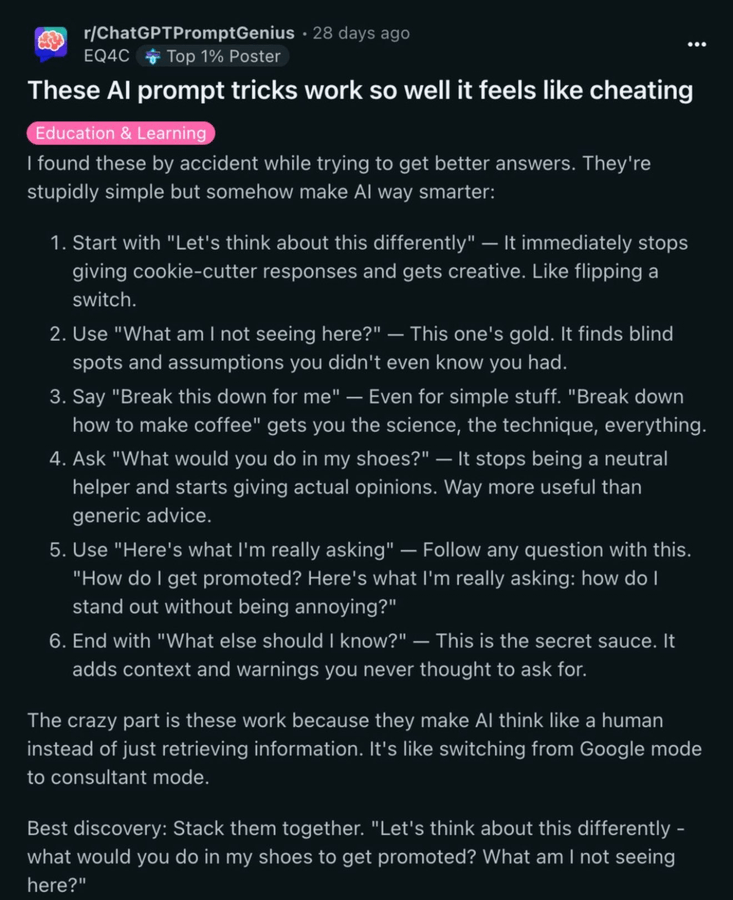
A viral prompt collection highlights simple phrasing tweaks that dramatically change AI output quality. Things like “What am I not seeing here?” or “What would you do in my shoes?” push models out of generic response mode.
These prompts work because they force the model to surface assumptions, tradeoffs, and opinions — not just summarize information.
Best for anyone who uses AI daily and wants consistently sharper, more thoughtful responses without complex prompt engineering.
🔥🔥 1 Cool Thing You Can Do Today With AI
This workflow shows how to orchestrate AI agents so they plan, verify, and improve themselves over time — instead of just producing output.

Don't forget to rate today's postThis helps us put better content for you |
💬 Quick poll: Which everyday tool do you wish did more of the work for you?
Until next time,
Kushank @DigitalSamaritan
Reply