- Practically AI
- Posts
- 🧠 What the latest AI race tells us about 2026
🧠 What the latest AI race tells us about 2026
Today in AI: Arena’s model ranking, Pickle’s pivot, and DeepSeek’s training breakthrough
👋 Hello hello,
The AI landscape just handed us three signals worth paying attention to.
Arena published a first-of-its-kind “top models by modality chart” — a snapshot of what the AI world actually uses across text, vision, web dev, search, and video. Pickle unveiled a shift in focus toward safer model collaboration and sustainability as it builds its platform.
And DeepSeek kicked off 2026 with a research paper proposing a fundamentally different way to scale large models with less compute overhead. 
If you’re tracking where real engineering choices are headed — not just shiny demos — this issue is for you.
Let’s dive in.
🔥🔥🔥 Three big updates
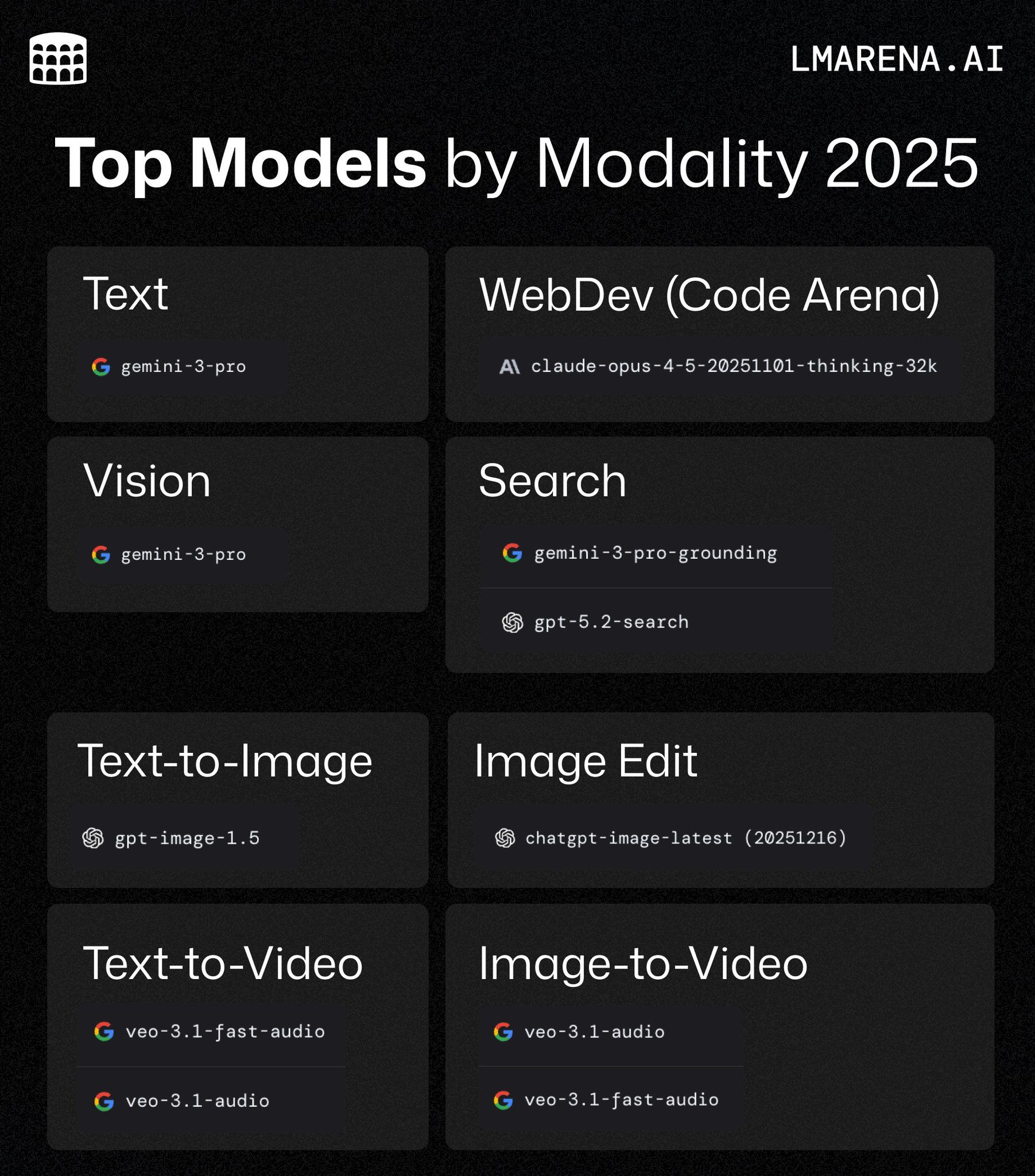
Image source: Arena X
Arena — the analytics lab known for benchmarking LLMs and tooling — published a top models by modality chart that highlights which models are leading across different categories in 2025 (text, vision, web dev, search, image, and video). It shows Google’s Gemini 3 Pro dominating text and vision slots, Claude’s Opus variant leading code tasks, and specialized video models like veo-3.1 pulling ahead in moving visuals. The breakdown gives a grounded, evidence-based look at which architectures are performing across real tests and contexts.
This kind of cross-modal ranking matters because it moves the conversation from “biggest model” to “most useful for task X.”
Pickle, a platform aiming to simplify working with multiple models and data sources, shared a strategic update announcing a broader focus on secure model collaboration and infrastructure workflows rather than just new model releases. While specifics on the roadmap are light, the message positions Pickle as part of the emerging layer that glues models and data together safely — a space that’s becoming increasingly important as teams build complex systems across vendors and formats.
This matters for teams trying to manage risk and coordination instead of wrangling dozens of isolated model endpoints.
DeepSeek — the Chinese AI company known for building competitive models with far less compute — published a new research paper outlining a training method called Manifold-Constrained Hyper-Connections (mHC). The idea is to let bigger models share richer internal information without destabilizing training or ballooning costs. Early tests on 3B, 9B, and 27B parameter scales reportedly show stable scaling with negligible extra cost, suggesting a new way to grow models without proportional compute increases.
The fact that DeepSeek’s founder co-authored the paper and uploaded it publicly adds weight to it — analysts see this as an early signal of how the company might build its next generation of models.
🔥🔥 Two tools worth trying
Flux provides a flexible interface for connecting multiple AI models, data sources, and workflows in one place. It’s especially useful for building dashboards, automating workflows, or integrating systems without manually stitching together half a dozen APIs.
Odysser — concept-first agent builder (beta-level)
Odysser is an early-stage agent platform focused on structuring tasks and logic with natural language. The idea is strong — turning descriptions into multi-step actions — but users should expect rough edges as the product continues maturing.
🔥 Prompt of the Week — AI portfolio landing page
If you haven’t tried it yet, VibeCode is an AI coding workspace that lets you build full-fledged web projects directly from prompts — no setup, no manual coding. Just describe what you want, hit enter, and watch it come to life in real time.
This week’s prompt is one of our favorites. Paste it directly into your VibeCode editor to generate a sleek, interactive personal portfolio page — complete with cursor effects, motion trails, and dynamic styling.
The result: a rich, high-impact web experience built entirely through AI — perfect for designers, developers, and creatives who want a portfolio that feels hand-crafted, not template-made.
Here’s a prompt you can paste directly into your VibeCode editor to generate a sophisticated personal landing page with interactive cursor effects:
I want to create a personal portfolio landing page for [YOUR NAME]. The page should be a full-screen hero section with a large headshot image [IMAGE ONE] as the background, centered and covering the entire viewport. My name should appear in the top left corner in a large, elegant serif font (like Playfair Display) with the first and last name stacked on separate lines. In the top right corner, add a "Portfolio" link. At the bottom right, include social media icons for Instagram, X/Twitter, YouTube, and LinkedIn that link to my profiles - use solid filled SVG icons so they're clearly visible. The main interactive feature should be a blob cursor effect that follows the mouse. When the user hovers over the page, an organic, gooey blob shape should appear and follow the cursor with a slight lag for a smooth, fluid feel. This blob should act as a "reveal" mask that shows a second version of the headshot [IMAGE TWO] - so as the user moves their cursor around, they're essentially revealing an alternate image underneath. The blob should have a trailing effect where smaller, fading blob shapes follow behind based on cursor speed - faster movement creates more pronounced trails. Add subtle animated wave lines in the background that respond gently to mouse movement. All text elements (my name, the Portfolio link, and the social icons) should dynamically invert to white when the blob cursor hovers over them, so they remain visible against the revealed image. The transitions should be smooth with a 300ms duration. Add a subtle parallax effect where elements shift slightly in the opposite direction of cursor movement to create depth. The overall aesthetic should be minimal and sophisticated with a white background, letting the photography and interactive elements be the focal point.
Do you like this new format? |
💬 Quick poll: What's the AI tool you use daily that nobody talks about?
Hit reply — We're always hunting for underrated gems.
Until next time,
Kushank @DigitalSamaritan
Reply